RICHeS funding secured for conservation research

Last week it was announced that Bristol Dockyards has secured £18,295 from the RICHeS Access Fund - the Research Infrastructure for Conservation and Heritage Science, funded by the Arts and Humanities Research Council (AHRC).
The funding will be used in a research project in partnership with Cardiff University and English Heritage, looking into how we can improve conservation of the SS Great Britain's iron hull whilst reducing our organisation’s carbon footprint. The RICHeS funding gives us access to equipment and expertise that would otherwise be beyond the reach of our charity.
About the research
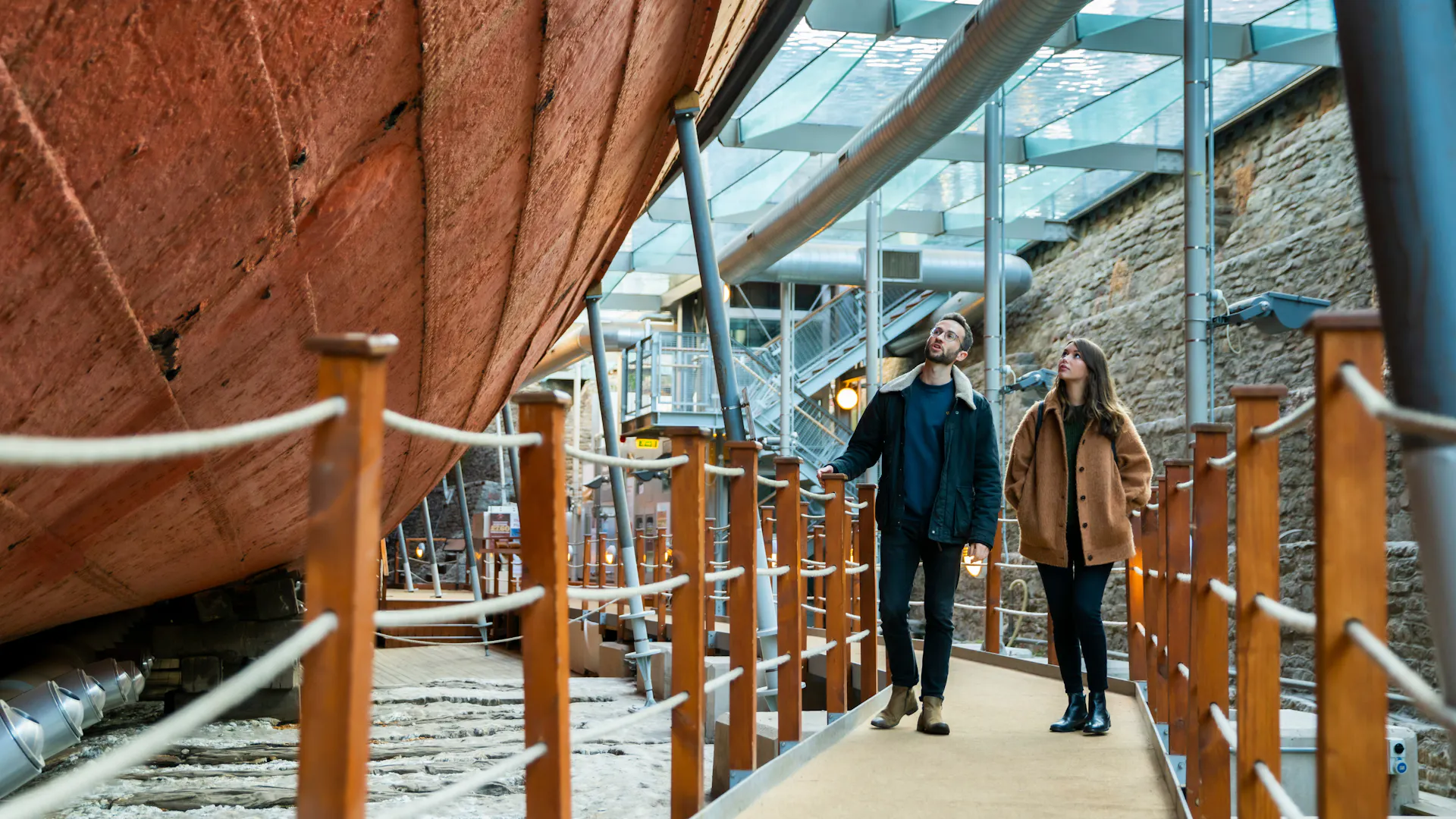
Since 1970, the SS Great Britain has been preserved in the very dry dock she was built in – although modified in 2005 to act as a giant dehumidifying chamber! A glass plate seals the dock at the waterline, and a system of dehumidifiers maintains the air surrounding the ship at 20% relative humidity (RH) – interrupting the corrosion process by removing the moisture that transforms Victorian iron into brittle rust.
The 20% RH level was set in 2005, using results from corrosion tests where laboratory-synthesised powders were used to represent a worst-case scenario, with high levels of chlorides acting as a catalyst speeding up degradation of the ship’s hull. A more recent 2019 study on archaeological iron samples found something striking: corrosion rates at 20% and 30% RH were almost identical, and even at 40% RH the difference was small. If that holds for marine iron too, our dry dock could potentially run at a higher RH level – meaning we can use significantly less energy whilst continuing to preserve the ship.
In partnership with Cardiff University and English Heritage, the research project aims to:
- Examine samples from the SS Great Britain and other historic marine objects to understand how they've degraded - and assess their suitability for testing
- Understand how corrosion risk changes at different humidity levels, potentially requiring less energy to maintain
- Establish how corrosion changes as temperatures rise, to support a more climate-resilient approach to conservation
Why is this important?
The results will help us implement a strategy that protects the SS Great Britain's hull while reducing the running costs and carbon footprint of our dehumidifiers. In the longer term, the findings will also shape the design of new, more energy-efficient equipment for the dry dock. Many organisations conserving marine iron objects are facing similar challenges – so, the data we gather has the potential to also benefit our peers in the heritage sector.
"We’re excited that the RICHeS Access Fund will allow us to progress this research. The project will provide crucial data to help us run our conservation system in a more environmentally friendly way and design a future system that doesn’t rely on fossil fuels to keep the ship safe for future generations to discover."