The Launch of the SS Great Britain, 1843
The Picture
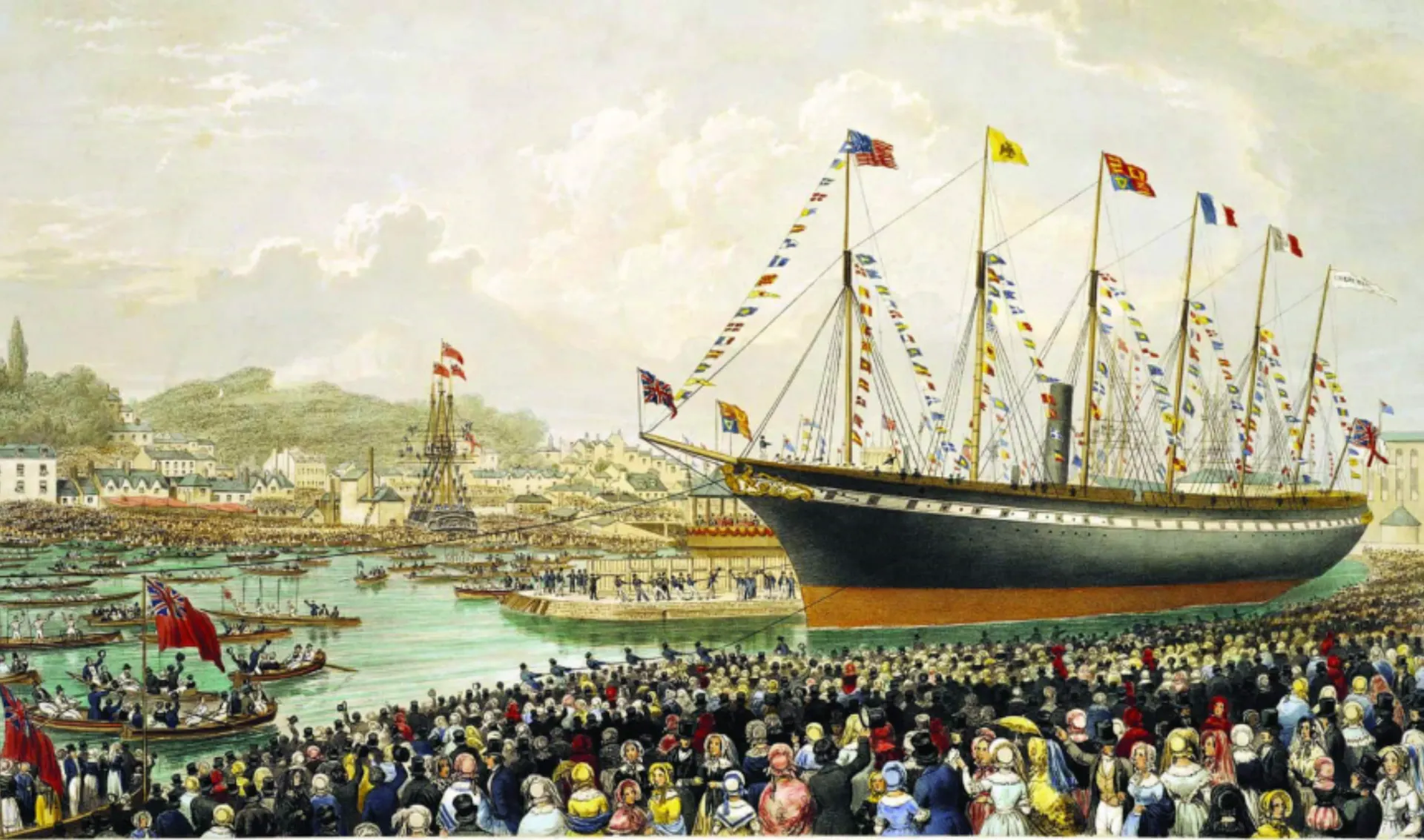
This image shows the SS Great Britain being launched into Bristol’s Floating Harbour on 19 July 1843. The launch attracted huge excitement: crowds gathered along the dockside, tickets were sold in advance, and Prince Albert attended as guest of honour.
Moving the world’s largest ship was not easy. If you look closely, you can see men positioned at the bow and stern helping to guide the vessel out of the Great Western Dockyard and into the harbour.
Today, visitors to the SS Great Britain can see the ship displayed as it appeared on its launch day, positioned in the very Dry Dock where it was originally built.
The Launch
The launch of the SS Great Britain was a dramatic and widely celebrated event. Prince Albert travelled from London to Bristol aboard Brunel’s Great Western Railway, where he was welcomed enthusiastically. Advertisements for the event even declared, “Prince Albert – To be seen alive!” highlighting the public excitement.
Like many ships of the era, the SS Great Britain was “christened” by smashing a bottle of champagne on her bow. Contemporary reports disagree over who performed the act. Some suggest Mrs Miles, wife of a local MP, carried out the launch, she had also christened Brunel’s earlier ship, the PS Great Western, in 1837. Other reports claim she missed the ship entirely and that Prince Albert, attempting to rescue the moment, threw a bottle from his table and successfully smashed it on the hull, showering onlookers with glass. With conflicting evidence, it remains unclear who actually launched the ship.
The Construction of the SS Great Britain
In 1843, the SS Great Britain became the world’s largest, longest, and first iron‑hulled, screw‑propelled ship. Brunel persuaded the Directors of the Great Western Steam Ship Company to abandon the original plan for paddle wheels and adopt the new, revolutionary propeller‑driven design. This innovation helped establish the SS Great Britain as the forerunner of modern shipbuilding.
The ship was constructed over four years by Bristol shipbuilder William Patterson in a specially built Dry Dock at the Great Western Dockyard. Brunel oversaw the project, and his Drawing Office still stands beside the ship today.
After her working life began, the SS Great Britain carried passengers between Liverpool and New York City, later travelling the globe for decades before returning to Bristol in 1970—127 years after her launch. She now rests in the same dock where her construction began, allowing visitors to explore her remarkable engineering story.
Joseph Walter
The launch scene was painted by Joseph Walter, a professional marine artist born in Bristol in 1783. Walter lived in Portishead and later near Bristol Cathedral. He may have spent time at sea, which would explain his detailed understanding of ships and maritime life.
He painted many scenes of Bristol’s Floating Harbour and Portishead, offering a valuable record of the city’s nineteenth‑century waterfront. His works featuring the SS Great Britain and Brunel’s earlier ship, the PS Great Western, were especially popular.
This particular artwork is a lithograph print, a method that allowed many copies to be produced and sold, helping to spread the fame of Brunel’s new ship.